
Environs Kimberley, Lock the Gate and Seed Indigenous Youth Climate Network are calling on Federal Environment Minister Senator Murray Watt to reject Black Mountain Energy’s proposed “Valhalla” fracking project, after approximately 8,000 people made submissions during the federal EPBC Act public consultation period which closed on Monday.
Environs Kimberley’s detailed submission argues that Black Mountain Energy has failed to provide the scientific evidence, field surveys and Traditional Owner consultation required to demonstrate that the project would not cause serious and irreversible harm.
The Texas-based company is seeking approval to drill and frack 20 gas wells in the catchment of the National Heritage-listed Martuwarra Fitzroy River. The proposal would require around two billion litres of groundwater.
Environs Kimberley Director Martin Pritchard said the strong public response reflected the national significance of the Martuwarra Fitzroy River and widespread opposition to fracking the Kimberley.
“Eight thousand people have taken the time to make a submission because they understand what is at stake,” Mr Pritchard said.
“The Martuwarra Fitzroy River is one of the world’s great free-flowing river systems and the spiritual heart of the Kimberley. It should not be put at risk for an experimental fracking project that could open the door to thousands of polluting gas wells.”
Lock the Gate WA Coordinator Simone Van Hattem said:
“The Federal Environment Minister Murray Watt has every reason to reject fracking in the Kimberley, it’s a toxic, polluting industry with no place in a tourism icon.”
Seed Indigenous Youth Climate Network National Director Angel Owen said:
"Every public comment represents someone who deeply cares about the Kimberley, protecting Country, communities and water. Together they send a clear message to the Federal Government: this project should not go ahead."
"The choice before Minister Murray Watt is bigger than just one project. Its about whether we continue expanding the fossil fuel industry while communities in the Kimberley and right across the country are already living through floods, heatwaves and worsening climate impacts."
Environs Kimberley’s submission includes more than twenty major failures including:
1. Flawed water and flood-risk assessments
Six independent expert reports submitted by Environs Kimberley challenge Black Mountain Energy’s claims that there are “no credible impact pathways” that could lead to damage to the region’s groundwater aquifers, rivers, wetlands or communities.
Independent experts identified major gaps in local groundwater data, uncertainty about connections between deep and shallow aquifers, and flaws in the company’s wastewater pond modelling. The submission warns that the company may have underestimated the maximum flood level at Noonkanbah by approximately 4.5 metres, potentially leaving three proposed frack well pads below that flood level.
“Black Mountain cannot credibly claim there is no risk to water when it does not have the local information needed to understand how the water systems, surface and underground, are connected,” Mr Pritchard said.
2. Waterways, wetlands and threatened species have not been properly surveyed
Black Mountain Energy has failed to identify and investigate numerous seasonal wetlands, surface-water features and potential groundwater-dependent ecosystems (GDEs) within and near the proposed well sites.
It has also failed to conduct a biological survey of Mount Hardman Creek, a major tributary of the Martuwarra Fitzroy River that flows through the project area and may provide critical habitat for threatened species.
Targeted surveys have not been undertaken for listed threatened species including the critically endangered Northern blue-tongued skink, Largetooth sawfish, Northern quoll and Northern brushtail possum.
“You cannot claim threatened species will be safe when you have refused to properly look for them or survey their habitat,” Mr Pritchard said.
3. Traditional Owners have not been adequately consulted
The proposal could affect the National Heritage values of the West Kimberley, including the living Rainbow Serpent traditions associated with the Martuwarra Fitzroy River and the ways water moves throughout its catchment.
The Commonwealth’s DCCEEW said that Black Mountain was to “Undertake engagement with those groups associated with outstanding heritage values of the Rainbow Serpent tradition...that are likely to be directly and indirectly affected by the proposed action, this includes Traditional Owner groups whose traditional Country and native title determination areas lie adjacent to or in the area likely to be directly and / or [are] indirectly impacted by the proposed action.”
Despite this, the submission says Black Mountain Energy has not consulted with Traditional Owners whose Country lies close to the proposed fracking operations.
“This appears to be fatal flaw by Black Mountain Energy and we don’t believe the Federal Environment Minister Watt can possibly approve a proposal with such obvious failings with regards to Traditional Owners,” Mr Pritchard said.
4. Chemical and wastewater risks remain unresolved
The company has not clearly disclosed which chemicals would be used, in what quantities, how toxic they may be individually or in combination, or how contaminated wastewater would ultimately be disposed of.
The submission also raises concerns about hydrocarbons, heavy metals, salts and naturally occurring radioactive materials that may be present in flowback and produced water.
“The public still does not know exactly what chemicals would be used or how toxic and radioactive waste would be safely managed in one of the most flood-prone parts of Australia,” Mr Pritchard said.
5. The true scale and climate impacts have been concealed
The 20-well proposal is an entry point to a much larger gas industry. Black Mountain Energy has publicly promoted full-scale development of its Kimberley gas resources, which would foreseeably require hundreds or thousands of wells, extensive roads and pipelines, massive groundwater extraction and a gas export pipeline potentially stretching more than 1,000 kilometres.
The submission cites analysis estimating that full development of Black Mountain Energy’s gas resource could generate between 8 million and 11.4 million tonnes of domestic greenhouse-gas emissions each year, excluding emissions from burning exported gas overseas.
“This is not simply about 20 wells,” Mr Pritchard said.
“It is about whether we allow the industrialisation of the Kimberley with potentially thousands of fracking wells, roads, pipelines and toxic wastewater ponds.
“The company has comprehensively failed to show that its proposal is safe. Minister Watt now has both the evidence and a clear message from 8,000 members of the public: reject Valhalla, protect the Martuwarra Fitzroy River and the Kimberley.”
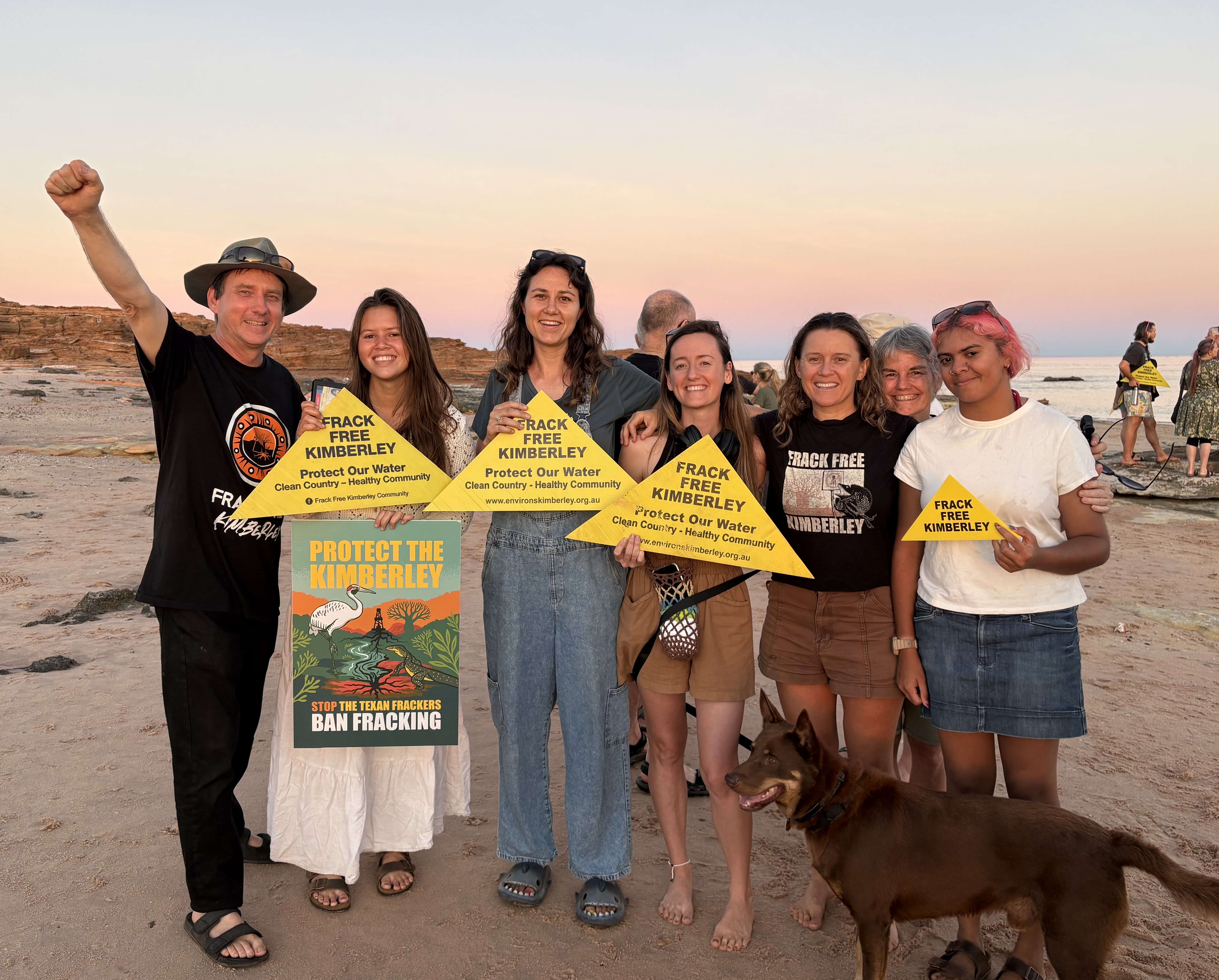
Image: Kimberley locals call for a Frack Free Kimberley.
Showing 1 reaction
Sign in with
Facebook