
The Broome Community Seagrass Monitoring Project is WA’s longest seagrass monitoring project, and one of Australia’s longest running citizen science project, regularly collecting data to monitor the health of Roebuck Bay since 2007.
What is seagrass?
Seagrass is the only flowering plant that lives entirely underwater, growing roots which anchor to the sea floor and producing flowers which are pollinated by the ocean’s currents or by marine animals, such as worms and small shrimp.
There are between 60-72 species of seagrass worldwide. Western Australia represents the highest global diversity with 25 species. In the intertidal zone (the area between high tide and low tide) of Roebuck Bay there are two main species which are narrow leaf seagrass (Halodule uninervis) and spoon grass (Halophila ovalis).

A meadow full of spoon grass seagrass at Town Beach, Broome.
Why is seagrass important?
Seagrass is one of the world’s most vital resources as it is responsible for supporting and protecting coastal ecosystems in more ways than you may think!
The leaves grow tall and create safe shelter for juvenile fish and crabs, as well as providing habitat for an array of marine animals, turning the meadows into biodiversity hotspots.
The plants have vertical roots for taking up nutrients as well as horizonal roots (rhizomes) to grow and spread across the bay. These, in turn, stabilise the sediment, helping to prevent coastal erosion.
Dugong and green sea turtle are culturally and ecologically important species which are dependent on seagrass as their main food source. One dugong may eat up to 40kg of seagrass per day!
Seagrass is also the most efficient carbon sink on Earth. By taking in excess carbon from the atmosphere and storing it in their roots and sediments, it plays a vital role in protecting us from the effects of climate change.

Did you know? Seagrass meadows support 40 times more animals than bare sand!
Seagrass is highly sensitive to environmental change, including declining water quality, excess nutrients from coastal runoff, and rising temperatures caused by marine heatwaves. By regularly monitoring seagrass, we can detect early signs of change in Roebuck Bay before impacts spread through the wider ecosystem.
What do we do?
The Broome Community Seagrass Monitoring Project was established in 2007, coordinated by Environs Kimberley in collaboration with Seagrass-Watch, Nyamba Buru Yawuru, Department of Biodiversity, Conservation and Attractions (DBCA) and our dedicated community volunteers. We are proud to be the longest running seagrass monitoring project in Western Australia, as well as one of the longest running citizen science projects in all of Australia.
The project follows the methodology of Seagrass-Watch, a global scientific seagrass monitoring organisation with 445 monitoring sites established in over 25 countries. Seagrass-Watch researchers provide consistent quality assurance checks on the data collected, ensuring our monitoring follows strict scientific protocols.
Learn about Seagrass-Watch here!

Volunteer with us
Community volunteers are vital to the success of our monitoring events as the data must be collected during a short window of time when the lowest tides occur in Roebuck Bay. Each survey takes approximately 2 hours and involves walking out across the mudflats, carrying a bucket of monitoring equipment and data sheets and making observations on health of the seagrass meadows. No experience is required as we teach you everything on the survey, with all ages welcome to join us.
To understand what the survey involves, watch our training video below.
Watch our pre-survey training video
By joining a survey, you are helping to collect important ecological data which will help us protect the health of Roebuck Bay. See our calendar for our upcoming survey dates and get in touch with our team if you would like to get involved.
Contact Alex, our Project Officer at [email protected] or phone 08 9192 1922
Resources
For an update on the health of seagrass meadows in Roebuck Bay and our citizen science achievements over the past year, read our latest report card below. As of 2025, seagrass meadows are in a ‘good’ state across all monitoring sites.
Broome Community Seagrass Monitoring Project Community Report June 2026
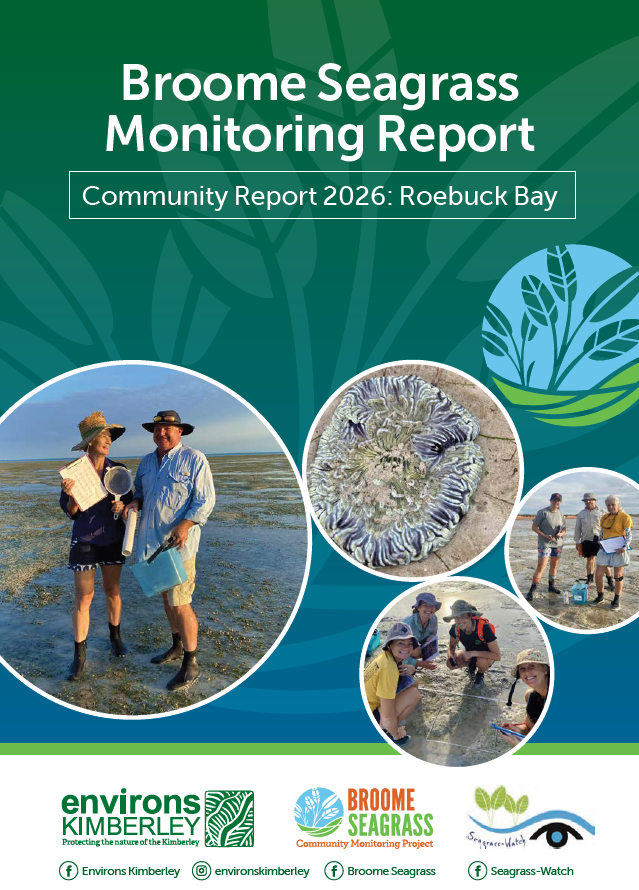
Read more about the project:
Broome Community Seagrass Monitoring Project Community Report June 2025
Long term results of Roebuck Bay
Current Funders:

Partners:
The Broome Community Seagrass Monitoring Project is coordinated by Environs Kimberley with the generous support of volunteers from the Broome community and:




Past Funders:
Australian Government National Landcare Programme
Government of Western Australia Natural Resource Management Program
Department of Biodiversity, Conservation and Attractions
Wettenhall Environment Trust
For more information:
Please email [email protected], or phone (08) 91921922.