
Broome-based conservation group Environs Kimberley (EK) is calling on the WA and Federal governments to reject the proposal from global sea cage fish farm developer Tassal to establish 84 barramundi sea cages across the remote, environmentally sensitive, National heritage-listed Buccaneer Archipelago north of Broome.
EK’s submission to the WA EPA assessment outlines seven of the reasons the proposal should be rejected.

Tassal, owned by Canadian giant Cooke Aquaculture Inc., is one of the companies involved in the ongoing salmon sea cage controversy in Tasmania. It recently acquired the existing, relatively small, Cone Bay barramundi sea cage operation in the Kimberley and has put forward a proposal to establish 84 sea cages spread across 50 km in the Mayala Marine Park which forms part of the National Heritage-listed Buccaneer Archipelago.
EK Executive Director Martin Pritchard said the marine and island environment of the Mayala Marine Park and Buccaneer Archipelago is incredibly significant for its environmental values and is no place for a high-risk industry like large scale sea cage fish farms.
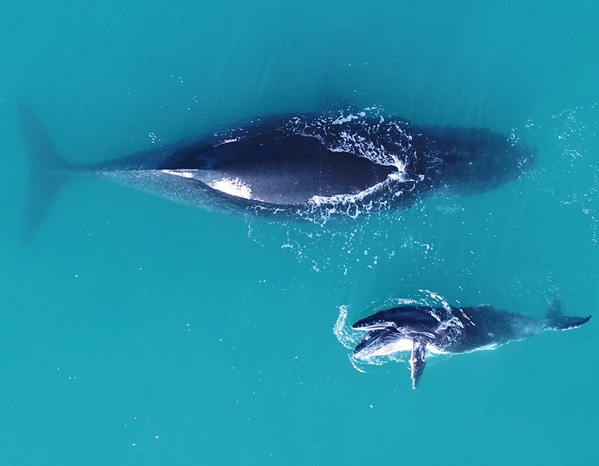
Humpback whale calf with its mother. Photo: Matt Deakin.
“Recent experience in Tasmania, and also a massive fish death event at Cone Bay in 2019, show that large scale sea cage fish farming brings many impacts and risks which under no circumstances should be imposed on a globally significant environment like the Buccaneer Archipelago.
“The Kimberley coast is in the top 4% of least impacted coastlines in the world. (Source: Halpern et al 2008)
“The marine environment of the Kimberley, including Buccaneer Archipelago, is a recognised stronghold for species like Humpback whales who give birth here, dolphins, dugong, turtles, rays and sawfish – species which are under increasing pressure elsewhere due to habitat loss, pollution, fishing and global warming.
“The Buccaneer Archipelago is also popular amongst recreational fishers who are concerned about this proposal.
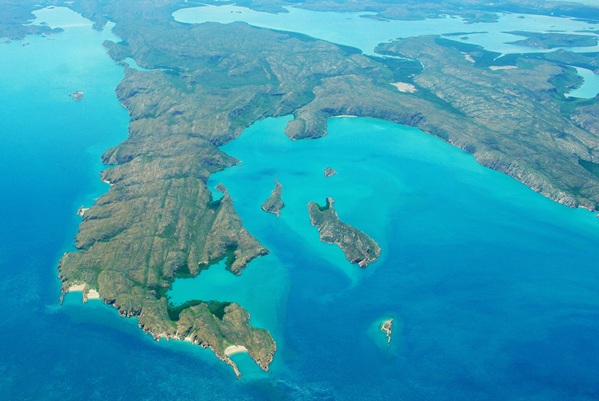
Cone Bay. Photo: Martin Pritchard.
“Here in the Kimberley these marine species have the world’s most pristine environment where they can migrate, breed, raise their young and feed in safety. The many islands too are incredibly significant as refugia for species whose populations have sharply declined on the mainland due to introduced species and changed fire regimes.
“Spreading sea cage fish farming through this remote and pristine marine and island environment brings many risks including pollution, introduction of pests and diseases, attraction of predators, interruption of breeding and feeding patterns, unauthorised access to islands and disposal of large volumes of dead barramundi.
“Because of its remoteness, high tides, fast currents, narrow channels (and cyclones), if there is a major event like mass fish escape or mass disease and death event, it will be logistically very difficult to address.
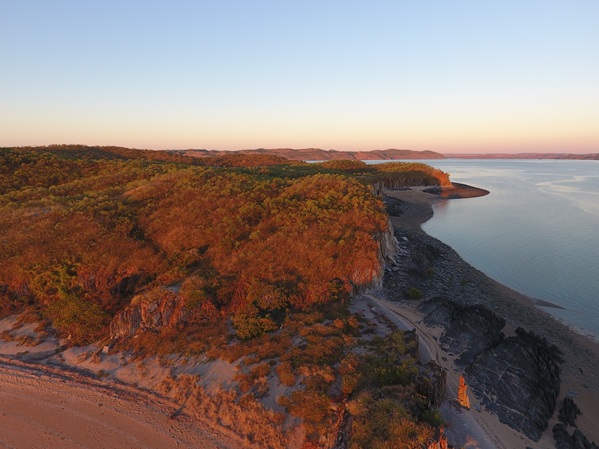
Edeline Islands. Photo: Martin Pritchard.
“There is absolutely no good reason to put at risk a unique environment like the Buccaneer Archipelago to grow barramundi in sea cages. Fish farming should be undertaken close to population centres and support services and should be developed as closed-cycle operations on land, not in the open sea. This is the case with barramundi farming in the Northern Territory.”
Read more: WA Today's report "Tarnished Tassal brand targets WA barramundi".
Showing 2 reactions
Sign in with
Facebook